Sunday Sermon – Reclaiming the Language of Faith – December 3, 2017

 Sermon (12/3/17) Reclaiming the Language of Faith

Rev. Paul D. Daniel, Minister

The use of religious language is primarily a philosophical problem

arising from the difficulties in accurately describing God.

Because God is generally conceived as incorporeal, infinite, and timeless,

ordinary language cannot always accurately capture those qualities….

This makes speaking about or attributing properties to God difficult:

a religious believer might simultaneously wish to describe God as good, yet

also hold that God’s goodness is unique and cannot be articulated by

relatively limited human language of goodness….

This raises the problem of how (and whether) God can be meaningfully spoken about at all,

which in turn causes problems for

religious belief since the ability to describe and talk about God is

important in religious life, even for non-believers.

Traditional theological language such as

God and Grace,

salvation and resurrection

soul and sacrament, etc. are

central in all sacred texts.

These words are powerful because of the vivid, stark and lush images they create in our mind; and for

the visceral effects they can have on us.

Like it or not, such words are embedded at the core of our civilization, pulsating at the very heart of our being.

Even today these old stories, metaphors and proverbs can

resonate for good or ill in our spiritual journey to faith….

In the beginning of everything, God created the heavens and earth and

spoke “Let there be light”, and it was brought into existence.

Through God’s action people and worlds are seemingly created or destroyed by an unfathomable entity with unimaginable power.

For many of us when we were children, the magic in these stories seemed so real.

As adults, these tales still resonate for some, but for many others they are

no more profound or different than fairy tales, like Cinderella or Pinocchio.

Some of us, especially gays, lesbians and many women still

struggle to cope with religious language that has been and still is

used to shame, judge, control, and oppress all marginalized groups….

My sermon today addresses this issue and calls us to reconsider and

deconstruct theological language as the way to reclaim our Judeo-Christian and other’s heritages of faith.

With translation and adaptation of such language to modern understandings, we can

return these words to their original majesty but without the judgment we felt….

I invite you to be aware of your reaction to theological language.

Do you shut down and tune out when hearing traditional religious language because?

in the past you were intimidated or marginalized by the demeaning usage of religious language?

Traumatized or not are you willing to keep an open mind,

stay in the conversation, and remain tolerant of theological prospective different from your own?

Can you hear the meaning beyond these emotionally charged words?

Former UUA president John Buerhens wrote,

“we religious liberals haven’t merely shot ourselves in the foot by

abandoning all the most powerful language and imagery of our culture.

We have shot ourselves in the mouth, where it is fatal.

We have turned this language over to the religious conservatives and they have run with it.

Our effort to communicate with the larger culture is a failure because

people do not find our language authentic to their life experiences and religious upbringing…..

We can however reclaim the common religious vocabulary–but,

with our own liberal religious meanings.

This is not a call for UUs to mimic mainline churches or to abandon other forms of religious dialogue, but rather

an appeal to stay in the conversation, and in so doing

move beyond our pain and misapprehension….

The effect of religious language can be experienced as a balm in Gilead or a deep wounding.

I belief that it is in our power to redefine and reimagine what religious words mean.

We can choose to use such words with a conviction biased towards

liberation and justice and not patriarchal oppression….

To say no to what denies or destroys is also to say yes to what affirms, lifts-up, and creates.

Such traditional language is rich in meaning and possesses a primitive, mystical incantational power that is difficult to deny.

That’s why many of us in our secreted heart love ritual and ceremonies….

William Ellery Channing tells us to

“prove all things, hold fast to that which is good; …

do not shrink from the duty of searching God’s word for yourself,

through fear of human censure and denunciation”.

These traditional words are an appropriate part of our UU vocabulary, as are the words from

our humanist, atheists, pagan earth centered traditions, Hindu and Buddhist teachings.

The trick is to balance their use, so that all of us within a congregation can feel included and uplifted….

All our words need to embody the spirit of love without

hurting our heart and spirit though misuse.

My objective is to make religious terminology accessible and

empowering to believers and non-believers alike….

Our challenge is to remain open to

our own theological evolution and its roadblocks; mindful

that revelation, new understanding is never closed.

Our revealed truth is still over the horizon, and our final understanding is yet to be written in stone.

What we know is the that use of religious words are a form of action,

capable of creating a reaction for good or ill, so

we are well advised use them with courage, sensitivity and caution….

If we are to move into a place of healing over these “forbidding words of faith” we need to re-think their meaning and usage.

For too long some of us have been held captive and terrorized by these words.

As I see it, we need to adapt traditional language to revive our liberal religion by

allowing us to address a wider audience by meeting people where they are religiously.

The unique inclusionary message of hope we Unitarian Universalist can bring to the world

must not be lost because we refuse to speak the language of most other faith traditions.

We can reclaim these words by redefining them for our time.

Perhaps, like some of you I too had to confront both Jewish and Christian images and

theological language I found distasteful.

As a young Jew, I heard stories about Christian prejudice and hatred towards Jews. I was called a Christ killer and told I would go to hell.

My own Old Testament upbringing was also frightening.

There was this angry, vengeful old guy killing and punishing Jews for

the least infringement of the “rules”. And let’s not talk about the flood!…

When I first became a UU 50 years ago, I was not sure our

historically Christian association could be a safe place for a Jew to worship.

I quickly found it was not a place to fear, but a haven.

I hope you also have found safety here.

Sadly, to many clergy and religious educators have been the source of dis-ease and condemnation because

they used theological language like a saber to cut deep into our psyches.

Even today, in an unguarded moment, we can be

humiliated and diminished by the misapplication of these ‘words of terror.’…

I am reminded of a true poignant story about a little boy named Richard, my life partner.

Like many he was coerced into going to church to build his “Christian character”.

He hated church because his priest, the nuns and Sunday school teachers told him that

he was a sinner, and that Christ had died for his sins.

That was a frightening, terrifying concept for a child of six or seven.

When he asked questions about how he had sinned; he was told that it was not his place to question the word of God but to repent.

With a growing skepticism Richard questioning increasingly put him at odds with the Catholic church.

In the process, they betrayed his trust and in so doing,

fused his embryonic faith to an experience of shame….

But, we have the power take back the meaning of religious words.

The philosopher Paul Tillich did that by calling God

the ground of all being, the God beyond God, the source of all courage.

UU can also use the word God in non-traditionally ways such as

the creative power of evolution in the universe, or

the ongoing power of love or simply ultimate mystery.

Such a God is neither male or female but

an all-inclusive representation of our highest values of truth, justice, love, and goodness,

We can never fully understand the nature of God, but

as Albert Einstein put it

“to know that what is impenetrable to us really exists…

this knowledge, this feeling, is the center of religion….

The blessing of our UU faith is that it arises out of our own understanding and experience,

which can open us to new love and meaning.

Our faith ultimately frees us from religious language that wounds.

When the language of faith stems from a holy place within,

we can finally recover its true intent and beauty and return

these once forbidden words to their rightful place in our liberal religious lexicon.

May it come to pass!

Virus-free. www.avast.com
Posted in Sermons | Leave a comment

Tree Trimming December 17, 2017

Trimming the tree at UUFP!

Please join us after service and help with trimming the tree. Join in the fun and the holiday spirit!

Posted in News of the Fellowship | Leave a comment

Sunday Service, December 3, 2017

Reclaiming the Language of Faith

Rev. Paul Daniel

Rev. Paul will speak about our UU reaction to the use of religious language. Our heritage derives from Jewish and Christian teachings, therefore their language of faith is the cornerstone of Unitarian Universalism. We can put up walls against religious language or we can translate the language of all faiths into a more universal UU perspective and understanding.

Posted in News of the Fellowship, Sunday Service | Leave a comment

Sunday Service, December 10, 2017

 It’s a small world after all The culture and people of the Amazon

Speaker: Linda Kozitzky         Lay Leader: Mary Ryan

In spite of the noticeable differences in climate and landscape, the indigenous people living at the head waters of the Amazon River in Peru are not that different from us with regards to their overall needs, wants and desires. Today we will share and discuss what 2 fellowship members learned on their recent trip to the Amazon.

Posted in News of the Fellowship, Sunday Service | Leave a comment

Sunday Service, December 17, 2017

 It’s a small world after all The culture and people of the Amazon

Speaker: Mary Ryan           Lay Leader: Linda Kozitzky

Nature has an amazing capacity to adapt to all types of environments. Today we will share and discuss the amazing animals and flora that exist along the Amazon River. 3rd Sunday Potluck will follow the service

Posted in News of the Fellowship, Sunday Service | Leave a comment

Sunday Service, December 24, 2017 @ 4 PM

Christmas Eve Service: Service at 4:00 PM

Merry Christmas

Rev. Paul Daniel

Rev. Paul’s Christmas Eve service will visit the story of Jesus from Mary’s perspective. He will delve into the very different Catholic and Protestant understanding of Mary and the role that sin plays in their differences.

Posted in News of the Fellowship, Sunday Service | Leave a comment

Sunday Service, December 31, 2017

Memories and Poetry

Lay Speaker CJ Rhoads

It’s time to dust off those favorite poems and bring them to share with the group! Poetry has the ability to evoke memories and touch our souls deeply. I’m CJ Rhoads, and I’ll be facilitating this popular annual service. December 31 is my Grandmother’s Birthday. She’d be 121 years old if she’d lived beyond 103, and she was one of the people who sparked my interest in poetry. I’ll be sharing several poems that she enjoyed.

Posted in News of the Fellowship, Sunday Service | Leave a comment

Sunday Sermon – Returning Home Where Hearts Meet Hearts – November 19, 2017

Ingathering-Water Communion

Returning Home Where Hearts Meet Hearts
Rev. Paul D. Daniel, Minister

Today we come together to celebrate life
symbolized by water. We come to celebrate
community; to celebrate the opportunity to be
with those we love in worship … , Every time we
meet in worship is a time of celebration. Let us
say Hallelujah together. Hallelujah!

We come together once again after being
scattered across the four corners of this globe.
Whether we left to avoid the heat, seek
adventure, find comfort in family and friends, find
a new way of dealing with the challenges of just
living, we welcome you back, old friends and
new. Our religious home is a place where we
offer our hand in friendship, where we open our
hearts to each other in love and compassion,
where we embrace the uniqueness of each of
us. If that is not a reason to celebrate I don’t
know what is. Let us say Hallelujah ….
Hallelujah!

We celebrate our coming together at the
beginning of each new church year. The clan

2

gathers, the wandering tribe begins to return;
soon our “snow birds” will begin to wing their
way home. The bringing of water from wherever
you traveled, or from your backyard pool and
kitchen faucet, symbolically represents the joy
we feel at this renewal of our sacred community.

Water is the symbol of ever renewing life.
Kathleen Korb writes, “I suspect that there really
are some theological aspects to the water
communion, although — it may well be true that
ritual precedes theology, and it was started, I
suspect, primarily for community-building and class
participation in show and tell. Water is basic to JifE?
on earth – all life, even the desert plants and
animals outside our windows — and I think it is
symbolic of the connection that we feel with one
another and all living things and the celebration of
life itself.” Perhaps this is an oversimplification of
the concept of the unity of all things, but we can
stretch a bit in our understanding of nature. We do
after all believe in the interconnected web of all
existence.

Part of the point of this ceremony, it seems to me,
is recognition that the same molecules of water
from my tap in Palm Desert once washed the
shores of Tasmania …. We know that we are all

3

connected, there is a unity in our diversity, in the
same way that streams become rivers that merge
into the sea.

Minister: It is written “the same stream of life
that runs through my veins, night and day runs
through the world and dances in rhythmic
measures.

Reader: It is the same life that shoots in joy
through the dust of the earth in numberless
blades of grass and breaks into tumultuous
waves of leaves and flowers.

Minister: It is the same life that is rocked in the
ocean-cradle of birth and death, in ebb and flow.

Reader: I feel my limbs are made glorious by the
touch of this world of life. And my pride is from the
life throb of ages dancing in my blood this
moment.“– (Rabindranath lagore).

Perhaps we don’t need water for this service of
renewal. We could just as easily use stones, or
special mementos from our summer to celebrate
our ingathering. What is really important is the
gathering of our beloved community after the
scattering of summer. It is a time to once again

4

share our life’s experiences. This ceremony calls
us to listen to one another’s story. The merged
waters become a symbol of our merged life
experience. “The water”, writes Sydney Wilde,
“is endowed with the spirit of our stories and
shared experiences of our lives. It becomes a
visible, tangible symbol of our community.

IT IS OUR COMMUNITY WHICH IS HOLY. It is
our community, which bestows blessings; and, we
as individuals create that community when we
share who we are, share our wisdom, share our
labor, share our stories, share our pain, our
losses- and share our vacations. We bring
ourselves back to this congregation where the
whole transcends the sum of its parts.

The Water Ceremony is a wonderful example of
the spirituality of humanism. There is no deity
here. The power of the holy resides in people,
people sharing their lives. This grows out of our
renewed awareness of the need for community
versus our traditional individualism.”

Whatever our motivation to gather, this is a service
of celebration. let us rejoice and say Hallelujah
together. Hallelujah!

Blessed be!

Posted in Sermons | Leave a comment

Sunday Sermon – We are the Builders of Dreams – November 5, 2017

11/5/17 Our 50th Anniversary

We are the Builders of Dreams

Rev. Paul D. Daniel


The  Rev. Patrick O’Neil  said “Here is what I know about communities of faith ( such as UUFP):


these are precious and rare, life-changing institutions, these little churches of ours.


They touch people and they are meaningful in people’s lives in ways that most of us can only guess at —


even those of us who have been active committed leaders ourselves for many years.


A church, finally, is nothing more than its people and what they bring to it:


their faith, their vision, their

collective hopes and dreams,

their memories and their customs,

their history, their prayers,

their good works, and their values.


And what community we are able to create here for ourselves is pieced together always with


painstaking love and unending patience, each one of us — shoemakers, cobblers, candlestick makers —


bringing one more thread to weave the fabric of this gathered community.”


And this my friends is reason enough for us to celebrate our 50th anniversary of bringing people together in faith and hope.


Gini Courter (former Chief Governance Officer of the Unitarian Universalist Association) delivered this 50th anniversary sermon at the Unitarian Universalist Church of Bowling Green November 4, 2012


which I feel is worth sharing with you for she speaks directly to us through the decades.


She said, “I do not know when it began, but you do.


It began with a discontent, a gnawing in the soul, an out-of-placeness.


It began with heresy.


Or perhaps it began with an expansiveness that drove you to seek, to inquire.


It began with thoughtful inquiry.


And it was a friend, an acquaintance, a colleague who was Christian, Jew, Moslem, a Buddhist stranger at the dentist’s office,


an unchurched but discerning woman on the bus who said “You sound like a Unitarian.”


A member of this congregation or another said “Come visit my church.”


And it wasn’t an intrusion, it was a kindness, a courtesy, and you found your way home.


No – I know you – some of you grew up in the church.


Your parents, or grandparents, or great grandparents trusted this faith with what they held most dear in the world:


the hearts, the minds, the very souls of the next generation.


During all your explorations, Unitarian Universalism was your church home, and


your sense of belonging has deepened throughout your life.


Nope. You searched on the web, you answered a survey on belief.net.


You entered some magic combination of words, clicked the I Feel Lucky button, and Googled your way to this saving faith.


I do not know when it began, but you do.


Remember your beginning and bring hold it within you for our time together this morning. It is time to celebrate.


We gather this morning in celebration of 50 years of religion woven from many strands,


inscribed in the gospel of universal salvation, tradition that proclaims the good news that every single person has inherent worth.


Even me. Even you.


Every individual has worth and every individual can have


a personal and direct relationship with the divine,


not because they learn the “right prayer”


or enact the “right ritual”, or make the “right confession” but


simply because they have a heart that beats, lungs that draw air, eyes that see, ears that hear, lips that can give witness –


each person has worth and dignity simply because they are.


Each human life connects, somehow, with yours and mine.


We know this. Sometimes we doubt, for a moment, or a year, or a decade and a half, but still we know this.


There is an entire world of people outside this sanctuary.


We could not ever hope to meet them all, and yet, we know in our bones that each person in that world has dignity, each person has worth.


For us, it is a matter of faith.


We know that each person gathered inside this sanctuary is also worthy.


I know – somehow, it gets harder to affirm inside the hall:


He took too long getting ready, she didn’t print the directions, he gave me a hard time yesterday, and


I still haven’t forgotten that comment she made at a congregational meeting in 1996.


The folks we know best are sometimes the hardest to love well.


I get up some mornings, and look in the mirror, and if there’s an argument against inherent worth,


I’m sure I’m looking at her.


Do you have days like that? You may not know that you are worthy, and I may not know that I am worthy.


And yet we are.


Every person in this room is a unique and wonderful blessing in the world.


So, let’s go show them. Please take a moment and greet your neighbors as the unique and wonderful blessings that they are.


Friends, we gather to celebrate a free faith that declares that every child, every youth, every woman, every man,


can be saved not just once, but again and again and again.


Salvation is ever present, universal and ubiquitous.


We are all saved. Even me. Even you.


We gather this morning to worship, to open our hearts to wonder – to the feel of your child’s hand in yours,


that look in the eye of the person you just greeted, to


a memory summoned forth by a piece of music, to the feeling in our body as we sing and sway.


We open our hearts so that something precious, something Holy can enter.


We might call this connection, or community, or God, or Holy Spirit, or Love, but that doesn’t matter.


It is here because it is invited, because we dared to create a welcoming space.


We gather to celebrate a lived faith, an embodied faith, a


faith that declares a ministry for each and every one of us, every woman, man, youth, and child.


We are all called, called to wake up, summoned to the religious life and none of us, not one of us,


can afford to walk through life sound asleep. All of us all called to ministry.


For some, answering that call means a life poured out in service in our Unitarian Universalist ministry.


In our 50 years, you have often been lay led, and also lead by a variety of ministries of various terms.


I am deeply grateful for our professional clergy, fine women and men, called to minister to us in times of joy and times of sorrow,


comfort us when comfort is called for, to help us make sense of the unevenness, the tragedies of life,


to never fail to be touched by human frailty and loss,


to work very personally but always on behalf of what we all hold holy, to bend our world toward justice.


But ordained or lay ministry is so much more, for if ministers only comfort, then we become a comfortable people.


If ministers only reassure, then we are so easily rocked, so easily gentled into complacent sleep.


We all need to wake up, for if ministers could do all the work needed to build the better world we proclaim,


why, then, do you and I even have hearts and hands?


There is a ministry for each of us.


You know this is true, because you have shared and practiced lay ministry here for 50 years.


In so doing this congregation has made the Pottstown, PA. area more accepting, more tolerant, more compassionate, a more caring community.


Here we are, in yet another difficult time to be socially progressive, to be religiously liberal.


I don’t need to tell you this. I think religious liberals were caught like a deer in the headlights when


we first came up against an organized effort to repeal the entire 20th century,


to return us to a time when environmental destruction is acceptable again, merely a cost of doing business,


when women’s rights were an afterthought,


when children routinely lived in poverty, when racial difference was used to divide and punish,


when we wage war without end.


Since the election, it has been a time of political arrogance and divisiveness not seen in this country since the Civil War.


Nazis march in our streets screaming “Jews will not replace us” and


white supremacist’s march with torches and hate filled speech murdering people who are peacefully counter protesting.


All the while, human rights and civil liberties are degraded even more,


our environment hovers on the edge of environmental disaster.

Hard times.


But when times are hard, remember – you are not alone.


And now, feel a thousand other UU congregations reaching out to you this morning.


Feel their thousands, the thousands of thousands.


They are here with you this morning, and every morning.


Think about the hymn we just sang, “For All That Is Our Life”.


It is a quintessential Unitarian Universalist hymn.


Is there suffering in the world, in our lives?


Is there fear and trepidation?


You bet there is.


We encountered those fearful hours in the middle of verse three.


And yet, unlike some other religions, we do not believe that fear and suffering are noble in and of themselves,


that we will be or have been saved through suffering – ours, or someone else’s.


We suffer, but we know we were not created to suffer.


We’re afraid, but we know we were not created to live in fear.


You and I were created to make creation itself a less fearful place, to ease suffering wherever we encounter it.


We are here to work, to reconstitute the broken pieces of creation into


a more just, more compassionate, less scary and more inclusive world.


So, I like the message, the theology of this third verse, too.


But it is the simple first verse repeated again at the end of the hymn that catches my heart.


For all that is our life we sing our thanks and praise
For all life is a gift that we are called to use
To build the common good and make our own days glad.


We can choose to build the common good, to


serve justice, to show mercy, to live epic lives of service, exemplary lives of compassion.


And if our own days are brightened as a result, well, that’s not an accident.


The gladness keeps us in the game, keeps us coming back for more day after day, year after year.


That’s how it’s worked for fifty years: with gladness.


You know that because you have been here.


Each of us has a ministry, our own piece of the world to make whole.


All our ministries are worthy.


The world is in desperate needs of every ministry that embodies our values, every ministry that


adds love and compassion to an apathetic, dispassionate world.


Perhaps you worry that you are not sufficient to the ministry you are being called to.


Do not worry – you will be. You and I do not need to be extraordinary people – just ordinary people with an extraordinary faith.


This is what Unitarian Universalists can create together: a Religious community bound together not with common belief,


with a promise – a promise – to create and with our faithful presence maintain the holy space in which we can


ask the questions that burn in each of our hearts:


How do I embrace the holy?
How am I called to serve?
What am I ready to commit in the service of a better world?
What do I value more than I value my own comfort?
Where am I willing to take a stand?


This is how ministries, and the courage to say Yes, are found.


Let us listen to each other so deeply, love each other so boldly, that


all of us can learn to listen to our hearts and find our courage.


May we see each other completely, hear each other fully


May we make choices that are bold, choices of meaning


May we learn to be both brave and humble warriors for our faith


May we be true companions to each other, full of patience and care and compassion,


willing to speak and hear each other to courage for the next fifty years, and the next, and the next.


Help us know that we can find in each other the strength to add to our strength so we may do the work that needs to be done.”


And now, after 50 years we are still fully awake,


may we find that the world we call ourselves to create together these next 50 years, is


so much more than anything any of us ever dared to dream.

Amen.


Posted in Sermons | Leave a comment

Ministers Musings

Where has the year gone? It’s hard to believe that Christmas madness
is just around the corner. It gives me the shudders even to think of it. Life is so much more then commerce and buying and selling and sales and returning “stuff”. And that’s just what it is…STUFF, of no real consequences or importance. But oh, Thanksgiving is so much more. It is a time of gratitude for the blessings of life, for family and friends, health and safety, our faith and this congregation.

It is also a time to be mindful that our bounty as a nation was founded on the genocide of our indigenous first peoples. A sad reminder that life is a mixed bag, good and evil entwined as part of our DNA. We celebrate our good fortune at the groaning board while people in Puerto Rico go homeless and hungry, no electricity and little water to sustain life. All the while our President threatens to cut off the insuffcient flow of vital aid because he thinks he is not getting the proper personal credit he deserves.

In this time of Thanksgiving and the approaching Christmas season it is time for us to slow down, take a deep breath and think about all we are grateful for. So, let us celebrate, but remember that our blessings are an incomplete picture for there are those who suffer. We people of faith owe those who have less: less joy, less freedom, less equality, less peace, a chance to share in the bounty of America. We should not have people dying each year because medical care is available only to the rich. People should not go hungry while we waste unfathomable amounts of food each year. According to the Guardian, Americans waste 60 million tons of food valued at 160 billion dollars of produce a year. That is 1/3 of all our food stuff. How can we allow that to happen when neighbors are going hungry?

To be fair and balanced (pun intended) we in this church individually and collectively do our part. We donate our garden produce to those in need. We help our members when they are hungry and sick. The challenge is the immensity of the need. It can overwhelm. When I think about all that needs to be done I am reminded of the painting, “The Scream” by Edvard Munch and its intense colors of despair. That is the way I sometimes feel in our quest to end human suffering.

But when I stop my self-indulgent complaining I realize that we can all do something no matter how small. “The mystery of human existence lies not in just staying alive, but in fnding something to live for”. (Isaiah Hankel). That is what this congregation, this faith is all about…helping us find a purpose in life, to leave this world a bettler place than we found it.

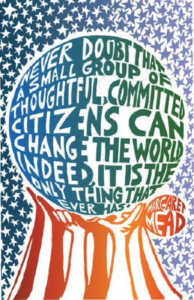
In that hope, and it is hope, is to address Margaret Mead’s words, “Never doubt that a small group of thoughtful, commited citizens can change the world. It is the only thing that ever has”. If we can do that, we can save the world and then truly celebrate with gratitude the strength of the human community. That possibility alone can give us hope. Together we can offer hope for the downcast and downtrodden. We can and do matter and for that we can be eternally grateful. Out of that place we can celebrate with Thanksgiving.

-Rev. Paul-

Posted in From the Ministers Desk, News of the Fellowship | Leave a comment